
It is one of the most common reactions people have at a dental visit. You go in feeling fine, expecting a routine checkup, and then your dentist says there is a cavity, early gum disease, a crack in a tooth, or an old filling that needs attention. Your first thought is usually the same: if nothing hurts, how can there be a problem?
It is a fair question. Pain feels like the clearest signal that something is wrong, so when there is no pain, treatment can feel surprising or even unnecessary. But in dentistry, pain is often a late sign, not an early one. Many dental problems can develop quietly for weeks, months, or longer before they become obvious. Early tooth decay often causes no symptoms at all, and gum disease usually starts with bleeding and inflammation before it turns painful. Cracks in teeth can hurt only once in a while, and failing fillings can hide new decay underneath them without much warning.
That is the real reason dentists sometimes find issues that patients do not feel yet. A good exam is designed to catch problems before they become painful, more invasive, and more expensive to fix.
Why pain is not the best early warning sign
Most people are trained to think of pain as the body’s alarm system. That is true in many situations, but teeth and gums do not always follow that rule neatly. A cavity can begin in the outer part of the tooth and stay symptom-free for a long time. MedlinePlus says early tooth decay usually does not have symptoms, and NIDCR says the same. By the time decay reaches deeper layers and starts causing sensitivity or a toothache, the problem is already further along.
The same pattern shows up with gum disease. Early gum disease often looks like red, swollen, or bleeding gums, but many people still do not feel actual pain. NIDCR explains that if gum disease is left untreated, it can spread to the bone around the teeth, eventually making chewing painful and, in more advanced cases, leading to loose teeth. That means waiting for pain is often the wrong strategy.
A simple way to think about it is this: no pain does not always mean no problem. Sometimes it just means the problem has not reached the stage where it hurts yet.
Myth vs. fact: “If I had a cavity, I would feel it”
This is one of the biggest myths in dentistry, and it is why routine exams matter so much.
The fact is that many cavities do not hurt at first. Early tooth decay often starts quietly, and most cavities are found during routine checkups before they cause clear symptoms. MedlinePlus says a dental exam may show that the tooth surface is soft, and X-rays can reveal cavities before they are visible during a normal visual exam.
Here is a realistic example. A patient comes in for a cleaning and feels completely normal. No pain, no sensitivity, no obvious hole in the tooth. On the X-rays, the dentist spots a cavity forming between two back teeth. The patient is surprised because nothing felt wrong. But that is exactly the point. Catching it there may mean a smaller filling instead of waiting until the decay reaches the nerve and causes pain.
The uncomfortable truth is that pain is often what happens after a cavity has had time to grow.
Myth vs. fact: “If my gums were unhealthy, they would hurt”
Not necessarily. Gum disease is often quiet in the beginning, which is part of what makes it so easy to ignore.
NIDCR says gum disease starts with swollen, red, and bleeding gums. Those signs may seem minor, especially if they come and go, but they still matter. If the disease continues, it can affect the tissues and bone supporting the teeth. That is when people may start noticing pain with chewing, gum recession, or teeth that feel loose.
A common example looks like this: someone notices blood in the sink when brushing, but there is no pain, so they assume they brushed too hard. That keeps happening for months. Eventually they notice bad breath, puffier gums, or more sensitivity near the gumline. The early warning signs were there all along. They just were not painful enough to force action.
Healthy gums usually do not bleed regularly. If they do, that deserves attention even if your mouth does not hurt.
Myth vs. fact: “A cracked tooth would hurt all the time”
Cracked teeth are tricky because the symptoms are often inconsistent. The American Association of Endodontists says cracked teeth can cause erratic pain when chewing or sensitivity to hot and cold, and the pain may come and go.
This matters because people often decide something is not serious if it is not constant. They may feel a sharp zing when biting into toast or nuts, then nothing for the rest of the day. That pattern can make the problem easy to dismiss. But intermittent pain does not mean the crack is harmless. It often means the crack is still small enough to behave unpredictably.
Think about someone who feels one sharp pain when biting on the left side, then starts chewing on the right to avoid it. That workaround can go on for weeks. But teeth do not repair cracks on their own. In many cases, delay simply gives the crack more time to deepen.
Myth vs. fact: “If I already have a filling there, that tooth is protected”
This is another assumption that gets people into trouble. Fillings repair a tooth, but they do not make it invincible.
NIDCR explains that even teeth with fillings are still at risk for decay, and plaque can build up underneath a chipped filling and cause new decay. NIDCR also cites research showing that 16% of tooth-colored fillings in a large U.S. sample failed within five years, with most failures linked to new cavities or tooth fracture.
A practical example would be an old filling that has been in place for years. The tooth does not hurt, so the patient assumes it is fine. During an exam, the dentist sees that the edge of the filling has opened slightly or that there is decay forming underneath it. From the patient’s point of view, nothing changed. From the dentist’s point of view, the tooth is showing early signs that it is no longer sealed and protected the way it should be.
That is why dentists pay attention to existing fillings and crowns during routine exams. The goal is not to create extra treatment. The goal is to catch failure before it turns into a larger repair.
Why dentists find problems before patients do
This part is important because it gets to the heart of trust.
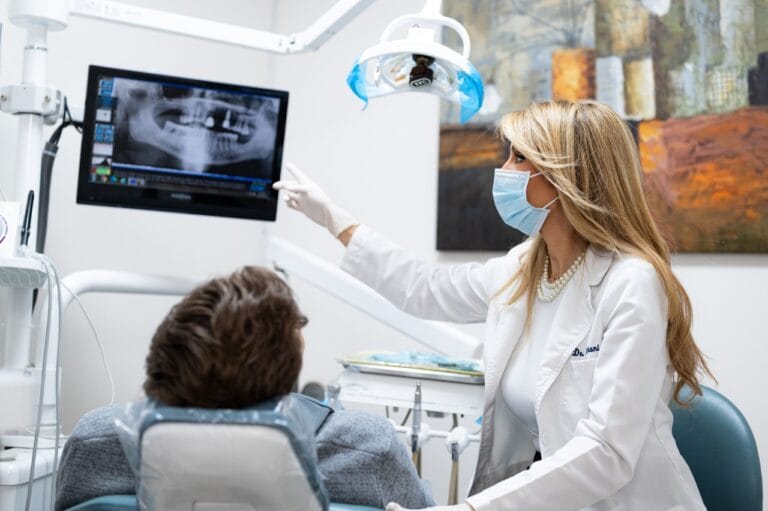
Dentists are not relying only on whether you feel pain. They are looking for changes in the tooth, gums, bone, bite, and restorations that may not be noticeable at home. That includes visual signs, probing around the gums, checking old fillings and crowns, and using X-rays to look for problems between teeth or below the surface. MedlinePlus notes that most early cavities are found during routine exams and that X-rays can show decay before it is visible in the mouth.
In other words, the exam is supposed to find things early. That is not a sign that something is being exaggerated. It is usually a sign that the exam is doing its job.
This is also why “I feel fine” should not be the only test you use to decide whether a finding is real. Many silent dental problems are only silent until they become more involved.
What to ask when your dentist finds a new problem
If a diagnosis surprises you, the right move is not to shut down or say yes blindly. Ask better questions.
Start with, “Can you show me what you’re seeing?” If it is a cavity, ask whether it is visible on the X-ray and where it is located. If it is gum disease, ask what signs point to it. If it is a crack, ask what symptoms or exam findings support that concern. If it is an old filling that is failing, ask whether there is new decay, breakdown at the edge, or fracture in the tooth.
Then ask, “How early is this?” and “What happens if we monitor it for now?” Those questions help you understand whether the issue is truly urgent, something to treat soon, or something that can be watched carefully. You can also ask, “What are my treatment options?” and “What happens if I wait?” A trustworthy dentist should be able to explain the reasoning in plain language.
Patients do not need less information. They need clearer information.
When a second opinion makes sense and when delay is the bigger risk
A second opinion can be reasonable, especially if a treatment plan feels large, expensive, or unexpected. That is not a betrayal of your dentist. It is part of making an informed decision.
But there is a difference between getting clarity and using uncertainty as an excuse to do nothing. If a problem is documented on X-rays, tied to visible gum inflammation, linked to a cracked cusp, or backed by clear clinical findings, indefinite delay is usually the riskier move. Silent dental problems do not become safer just because they are painless.
CDC’s 2024 surveillance findings show nearly 21% of adults aged 20 to 64 have untreated decay. That is a useful reminder that untreated dental disease is common, and one reason it stays common is that people often wait for symptoms to force action.
The smarter standard is not “Does it hurt enough yet?” It is “Do I understand what the dentist found, what it means, and what could happen if I leave it alone?”
The bottom line
If your dentist finds a problem and you are not in pain, that does not automatically mean the problem is small, fake, or safe to ignore. It often means it was caught early. That is usually a good thing.
Cavities can start without symptoms. Gum disease can progress quietly. Cracked teeth can hurt only once in a while. Fillings can fail underneath the surface without making a dramatic announcement. The absence of pain is not proof that nothing is wrong. It is sometimes just the short window where treatment is simpler than it would be later.
If a diagnosis catches you off guard, ask questions. Ask to see the evidence. Ask what stage the problem is in and what your options are. But do not make the mistake of using “it doesn’t hurt” as the whole decision.
That is how small dental problems become much bigger ones.
A note from Premier Care Dental Group
If you have been told you have a cavity, gum problem, cracked tooth, or failing filling and you are unsure what it means, getting a clear explanation matters. Premier Care Dental Group provides comprehensive dental care in Pasadena for children and adults, and our team can help you understand what was found, what needs treatment now, and what your options are moving forward. If something has been flagged during your checkup, call (626) 669-3141 or request an appointment to have it evaluated before a quiet problem turns into a painful one.